
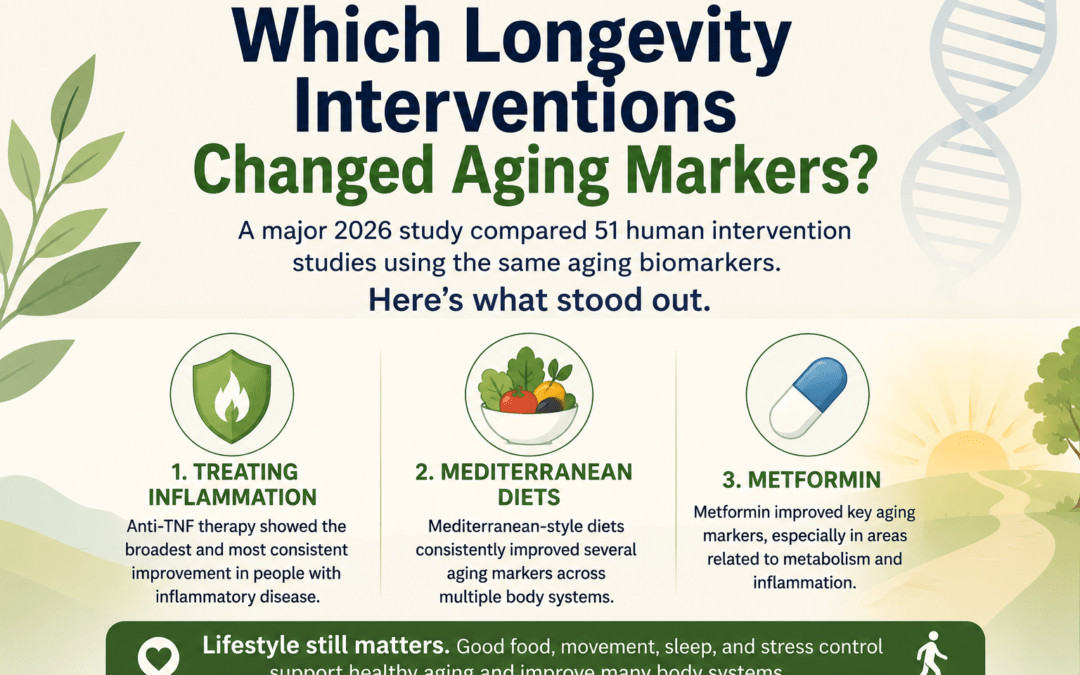
Which Longevity Interventions Actually Changed Biological Aging Markers?
There are many claims about slowing aging.
Some focus on supplements. Others focus on medications, fasting, special diets, or anti-aging treatments.
However, one major problem has made these studies hard to compare: researchers often use different biological aging tests.
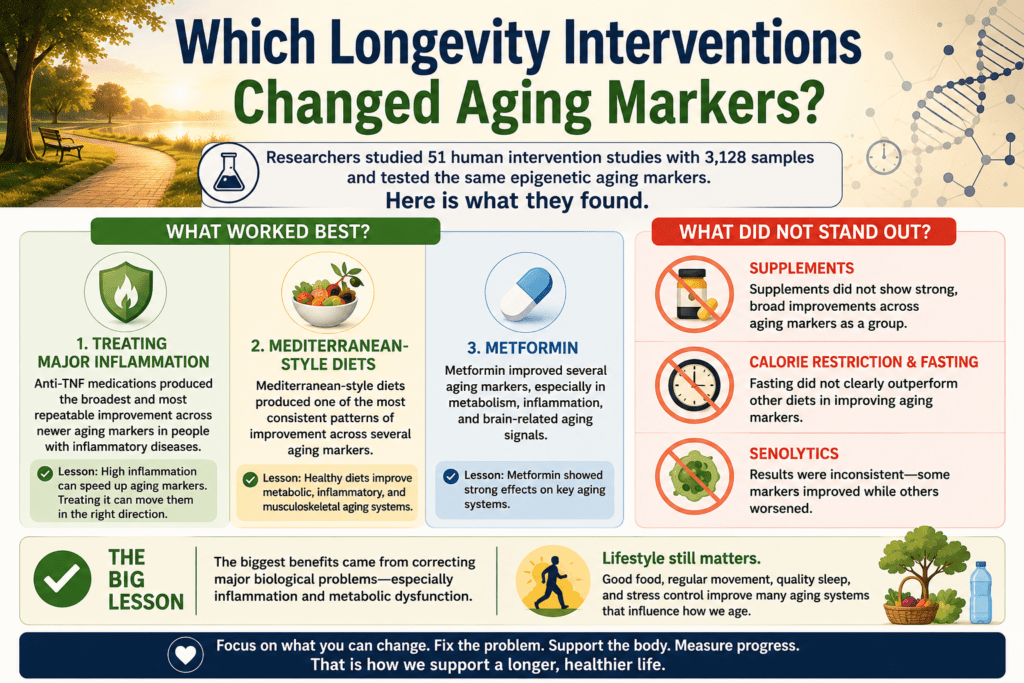
A 2026 Nature Medicine study tried to solve that problem. Researchers looked across 51 human intervention studies with 3,128 samples and tested the same major epigenetic aging markers across them.
That gave them a better way to ask:
Which longevity interventions changed several biological aging markers in the same positive direction?
The answer was surprisingly clear.
The Biggest Finding
Not all biological aging tests are equally useful.
Some older epigenetic clocks mainly estimate how old a person is.
Newer clocks try to measure things that matter more for health, including:
- Risk of disease – all-cause mortality
- Risk of death
- How quickly the body is aging
- Changes in specific body systems
The newer clocks responded much more clearly to lifestyle and medical interventions.
One of the most responsive was DunedinPACE, which estimates how quickly a person is aging biologically.
This means that when someone says an intervention “reversed biological age,” the first question should be:
Which clock did they use?
What Worked Best?
Three approaches stood out.
1. Treating Major Inflammation
Anti-TNF medications produced the broadest and most repeatable improvement across the newer aging markers.
Researchers studied these medications in people with inflammatory diseases such as arthritis and inflammatory bowel disease.
That does not mean healthy people should take anti-TNF drugs for longevity.
Instead, the finding shows something more useful:
Severe chronic inflammation can push several aging-related markers in the wrong direction, and treating that inflammation can move them toward a healthier pattern.
This supports a practical idea.
If someone has a major inflammatory problem, controlling that problem may do more for healthy aging than simply adding another “longevity” supplement.
2. Mediterranean-Style Diets
Among lifestyle approaches, Mediterranean-style diets produced one of the most consistent patterns of improvement.
The effects were not as large as those seen with some medications. However, several aging markers moved in the same favorable direction.
That matters because a small change that appears across several related markers may be more meaningful than one dramatic change in a single test.
The study also found that different healthy diets often improved:
- Metabolic aging
- Inflammatory aging
- Musculoskeletal aging
So diet may not simply change one “biological age” number.
Instead, it may improve several systems that influence how we age.
3. Metformin
Metformin also improved several important aging markers.
Its strongest effects appeared in areas related to:
- Metabolism
- Inflammation
- Brain-related aging signals
However, this study does not prove that healthy people should take metformin to live longer.
It shows that metformin can change certain aging-related biomarkers, especially in areas where it already has known metabolic effects.
What Did Not Stand Out?
Some popular approaches did not produce a broad, consistent anti-aging pattern.
Supplements
Supplements did not perform as strongly as a group.
That does not mean supplements are useless.
A supplement may still help when someone has a deficiency or a specific biological need.
However, this paper did not show that supplements as a category produced strong, broad changes across biological aging markers.
Calorie Restriction and Intermittent Fasting
Calorie restriction and intermittent fasting were included in the analysis.
However, they did not clearly outperform the other diets.
That is important because fasting is often promoted as one of the most powerful longevity tools.
This paper does not support saying it was the best approach for improving epigenetic aging markers.
Senolytics
Senolytic treatments produced inconsistent results.
In some studies, certain aging markers improved while others moved in the opposite direction.
That does not prove senolytics do not work.
Instead, it means the human epigenetic data are not yet consistent enough to say that senolytics reliably slow biological aging.
The Most Important Lesson
The study did not find one magic anti-aging intervention.
Instead, the strongest results usually appeared when an intervention corrected a major biological problem.
For example:
- High inflammation improved when inflammation was treated.
- Metabolic problems improved with metabolic treatment.
- Healthy dietary patterns improved several aging-related systems.
That leads to a better longevity question.
Instead of asking:
“What is the best anti-aging treatment?”
Ask:
“What part of my physiology is aging poorly, and what would improve it?”
That is a much more useful approach.
Why Lifestyle Still Matters
One of the most encouraging findings is that lifestyle interventions produced meaningful improvements.
The changes were often smaller than those produced by medications. However, lifestyle interventions are also more broadly useful for healthy people.
A good lifestyle can influence many aging systems at the same time.
For example, the right diet can improve:
- Blood sugar control
- Inflammation
- Body composition
- Vascular health
- Muscle health
- Metabolic flexibility
Exercise, sleep, stress regulation, and daily routine can influence many of those same systems.
This matters because aging does not happen in one place.
It happens across the whole body.
Therefore, the best lifestyle approach is not one designed simply to “hack” one aging clock.
It is one that improves the systems that most strongly affect long-term health.
How This Fits Into My Book Healing in Order
Healing in Order is built around the idea that the body must be helped in the right sequence.
This study fits that idea well.
It suggests that the strongest longevity effects may come from correcting the biggest biological burden first.
If inflammation is the major problem, address inflammation.
If metabolism is the major problem, improve metabolism.
If lifestyle is creating risk, improve the lifestyle.
Then measure whether the body changes.
The goal is not to chase a lower biological age number.
The goal is to improve the biology that the number is trying to measure.
What This Paper Really Showed
The most important conclusions are simple:
- Newer epigenetic clocks appear more useful than older clocks for measuring response to intervention.
- Anti-TNF treatment produced the broadest epigenetic improvement in people with inflammatory disease.
- Mediterranean-style diets produced one of the strongest and most consistent lifestyle responses.
- Metformin improved several metabolic and inflammatory aging markers.
- Supplements, senolytics, and fasting did not clearly outperform the other approaches.
- Lifestyle and longevity interventions can still improve several systems involved in healthy aging.
However, the study did not prove that any of these interventions make people live longer.
That question still requires long-term outcome data.
Final Perspective
The best lesson from this research is not that one drug or one diet defeated aging.
It did not.
The deeper lesson is that the body seems to age better when major sources of dysfunction are corrected.
Inflammation matters.
Metabolism matters.
Diet matters.
Lifestyle matters.
And the right longevity interventions depends on the problem you are actually trying to solve.
Healthy aging is probably less about finding one powerful anti-aging treatment and more about repeatedly doing the things that keep the major systems of the body working well.
That is less dramatic.
It is also much more useful.
Research Source
Sehgal R, Borrus D, Armstrong JF, et al.
Responsiveness of epigenetic aging biomarkers to longevity interventions in humans.
Nature Medicine. 2026.
DOI: 10.1038/s41591-026-04562-9