
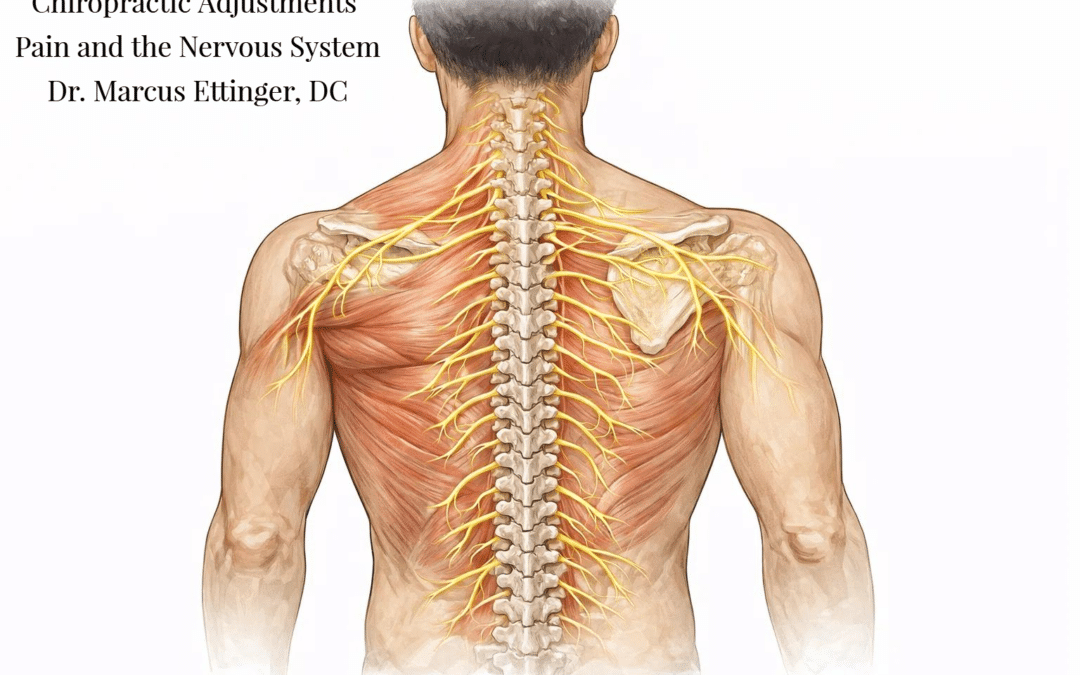
Can a chiropractic adjustments change pain signals in the nervous system? Research suggests it can influence certain pain responses for a short time. The more important question is whether that change helps a person move, work, sleep, and live with less pain.
After practicing chiropractic since 1989, I find this distinction useful. A treatment response may be noticeable right away. However, immediate relief and lasting improvement are not the same thing. To understand what chiropractic adjustments can and cannot do, we need to separate nervous-system experiments from clinical trials that measure patients’ lives.
A 2021 review in the European Journal of Pain explored possible neurological mechanisms. A larger 2026 Cochrane review then examined treatment results in adults with chronic low-back pain. Together, they provide a more balanced picture.
Contents
- Why Pain Is More Than a Joint Problem
- What the 2021 Review Examined
- How Adjustments May Change Pain Processing
- What About Central Sensitization?
- Brain Activity and Inflammation: What Remains Unclear
- What Newer Clinical Trials Show
- What This Means for Your Care
- Safety and Important Limitations
- Five Clinical Pearls
- Frequently Asked Questions
- The Practical Bottom Line
- Research Sources
- About the Author and Local Care
Why Pain Is More Than a Joint Problem
When a muscle, disc, ligament, or joint is irritated, specialized nerves can send danger-related signals toward the spinal cord. The brain then interprets those signals alongside many other inputs. Pain is a protective experience, but it is not a direct meter of tissue damage.
For example, two people may have similar spinal imaging results but very different symptoms. Pain can also continue after an injury has healed. These experiences do not make pain imaginary. They show that the body’s pain system can become more or less responsive over time.
That is why the question of chiropractic adjustments and pain relief cannot be answered only by discussing the position of a vertebra. We must also consider sensory processing, movement, daily activity, and recovery.
What the 2021 Review Examined
Gevers-Montoro and colleagues reviewed studies about spinal manipulation for back and neck pain. The authors examined three broad areas: effects in tissues and peripheral nerves; changes within the spinal cord; and responses involving the brain.
The publication was a narrative review. It brought together earlier human and animal experiments, but it did not enroll new patients or test one standardized chiropractic treatment plan. Therefore, it helps explain possible mechanisms; it does not by itself prove that a particular adjustment causes lasting recovery.
The strongest mechanistic case in the review involved short-term changes in pain sensitivity near spinal regions linked to the area receiving manipulation. Claims about systemic inflammation, cortisol, and specific brain mechanisms had weaker support.
How Chiropractic Adjustments May Change Pain Processing
Temporary Changes in Pain Sensitivity
Some experiments measured pressure-pain thresholds: the amount of pressure a person can tolerate before reporting pain. Following spinal manipulation, thresholds sometimes increased in related body regions. In plain language, the area became temporarily less sensitive to pressure.
Scientists call this segmental hypoalgesia. It suggests that input from a manipulated spinal region may influence pain-related processing within linked segments of the spinal cord.
However, in some experiments these effects lasted less than ten minutes. Other studies found that gentler mobilization produced similar responses. Still others, including sham-controlled studies, did not find clear differences. Thus, chiropractic adjustments can produce measurable sensory changes in some settings, but the response is not universal or necessarily unique to a rapid thrust.
A Sensory Change Is Not a Structural Diagnosis
When sensitivity changes after treatment, that does not establish that one vertebra was the original cause of pain. Nor does it prove that a joint has been permanently realigned.
Instead, these findings support a narrower and more useful point: mechanical input to the spine may temporarily change how some painful signals are processed. Whether that matters clinically depends on what happens to the patient’s symptoms and function afterward.
What About Central Sensitization?
People with persistent pain sometimes react strongly to ordinary touch, movement, or pressure. One possible contributor is central sensitization, in which parts of the central nervous system become more responsive to input.
The 2021 review also considered temporal summation. This describes how repeated stimulation can feel progressively more painful even when each stimulus stays the same. Some experiments found reduced temporal summation after manipulation, while other trials did not.
These findings are interesting because they suggest that pain sensitivity is changeable. They do not show that chiropractic adjustments reverse central sensitization in a reliable or permanent way. A patient with complex persistent pain may also benefit from appropriately paced activity, exercise, education, sleep support, or other care tailored to the condition.
Brain Activity and Inflammation: What Remains Unclear
Does an Adjustment Reset the Brain?
Some imaging studies have reported changes in brain activity after spinal manipulation. Yet researchers cannot always tell whether these changes reflect the treatment itself, altered incoming sensory signals, pain relief, attention, or expectations.
A brain scan may show a response without proving that the brain was “reset.” Likewise, observing a neurological signal does not establish better health or improved function months later. The 2021 review found insufficient evidence to identify a specific brain-level mechanism that explains clinical pain relief.
Do Adjustments Reduce Inflammation?
Small studies have examined cortisol, inflammatory signaling molecules, and markers of oxidative stress after manipulation. Results have been inconsistent, and some findings come from animal research.
As a result, it would be premature to claim that chiropractic adjustments reliably lower body-wide inflammation, normalize cortisol, or treat immune disorders. Biological ideas should be tested against meaningful patient outcomes before they become treatment claims.
What Newer Clinical Trials Show About Chiropractic Adjustments
Mechanism research answers how might this work? Clinical trials ask a different question: does this help people?
In January 2026, a Cochrane review evaluated spinal manipulative therapy for adults with chronic low-back pain. It included 76 randomized trials with 11,866 participants. The review covered manipulation delivered in different settings and did not test only chiropractic care.
Compared with sham or placebo procedures, spinal manipulative therapy was associated with an average pain reduction of roughly 7 points on a 100-point scale at about one month. The researchers rated that evidence very low certainty, meaning the true effect could differ substantially from the estimate.
Compared with other conservative treatments, the average difference in pain was small, with little to no meaningful advantage suggested by the pooled findings. Some functional measures favored manipulation modestly. However, the studies differed in techniques, treatment schedules, populations, and methods.
The World Health Organization’s 2023 guideline says spinal manipulative therapy may be offered as part of care for adults with chronic primary low-back pain. That is a conditional recommendation based on very low-certainty evidence, not an endorsement of one technique for everyone.
Therefore, chiropractic adjustments may be a reasonable option for selected patients with low-back pain. The evidence does not justify promising dramatic relief or claiming superiority over exercise, education, or other appropriate conservative care.
What This Means for Your Care
I believe a good care plan starts with understanding the patient’s problem, not choosing a technique in advance. History, examination, symptom patterns, neurological findings, goals, and potential risks all matter.
Someone with uncomplicated mechanical back pain may consider manipulation or mobilization. Another person may need more emphasis on activity, exercise, or medical evaluation. Many people benefit from combining approaches rather than relying on one treatment alone.
When judging progress after chiropractic adjustments, I would look beyond whether an immediate change was felt. More useful questions include:
- Is movement becoming easier during ordinary daily tasks?
- Is pain interfering less with sleep, work, or exercise?
- Are improvements lasting between appointments?
- Can the person gradually return to meaningful activities?
- Does the benefit justify the time, cost, and potential risk?
An audible joint sound, a temporary pressure-threshold change, or a strong sensation after treatment is not a substitute for sustained functional progress.
Safety and Important Limitations
Spinal manipulation is not appropriate for every patient. Short-lived soreness, stiffness, or an increase in discomfort may occur. Serious complications are uncommon, but trials are often too small and adverse-event reporting too incomplete to estimate rare risks reliably.
High-velocity cervical manipulation deserves particular attention to informed consent and possible vascular concerns. New, unusual, or severe head or neck pain, especially when accompanied by dizziness, visual changes, speech difficulty, or other neurological symptoms, requires prompt medical assessment rather than routine treatment.
Progressive weakness, bowel or bladder changes with possible spinal nerve involvement, suspected fracture, infection, or malignancy also require timely medical evaluation. Individual examination and risk assessment should guide whether any manual treatment is appropriate.
Finally, the 2021 narrative review cannot tell us the ideal visit frequency, which technique is best, or whether everyone needs ongoing maintenance adjustments.
Five Clinical Pearls
- Pain is not a simple damage meter. The spinal cord and brain help shape how pain is experienced.
- Immediate changes may be real but brief. A temporary shift in pain sensitivity is not proof of lasting recovery.
- Manipulation is one option, not the only option. Mobilization and other conservative approaches can produce overlapping effects.
- A measured mechanism is not a clinical guarantee. Changes in brain activity or inflammatory markers do not prove broad health benefits.
- Follow function over time. The patient’s sustained ability to move and participate in life matters more than any single treatment response.
Frequently Asked Questions
Do chiropractic adjustments affect the nervous system?
Some studies suggest they can temporarily alter pain-related sensory responses. Researchers have not established that an adjustment resets the entire nervous system.
Can an adjustment help chronic low-back pain?
It may help some people. The 2026 Cochrane review found possible small benefits, but results varied and the certainty of evidence was low to very low. A clinician should discuss other conservative options as well.
Does a popping sound mean an adjustment worked?
No. A joint sound is not a reliable measure of pain relief, improved function, or long-term treatment success.
Can adjustments permanently reverse central sensitization?
Current research does not establish that outcome. Some experiments show temporary sensory changes, but durable clinical effects need better study.
The Practical Bottom Line
Research on chiropractic adjustments and the nervous system is worth taking seriously, but it deserves precise interpretation. Spinal manipulation may change pain processing in certain circumstances. It does not follow that every proposed neurological mechanism has been proven or that each immediate response will last.
For patients, the most important outcome is not what a scan, laboratory marker, or joint sound suggests. It is whether care helps them move more comfortably, do more of what matters, and maintain those gains.
Research Sources
- Gevers-Montoro C, Provencher B, Descarreaux M, Ortega de Mues A, Piché M. Neurophysiological mechanisms of chiropractic spinal manipulation for spine pain. European Journal of Pain. 2021;25:1429–1448. DOI: 10.1002/ejp.1773.
- de Zoete A, et al. Spinal manipulative therapy for adults with chronic low back pain. Cochrane Database of Systematic Reviews. 2026. DOI: 10.1002/14651858.CD008112.pub3.
- World Health Organization. WHO guideline for non-surgical management of chronic primary low back pain in adults in primary and community care settings. 2023. WHO guideline.
About the Author and Local Chiropractic Care
Marcus Ettinger, D.C., practices chiropractic and functional medicine at Advanced Healing Center of Orange in Orange, California. He has practiced chiropractic since 1989 and earned his Doctor of Chiropractic and B.S. in Human Biology degrees from Southern California University of Health Sciences, formerly Los Angeles College of Chiropractic. Learn more on his professional biography.
If you are dealing with ongoing back or neck pain, an individualized history and examination can help determine which options make sense for you. Explore the practice’s chiropractic and related services, or call 714-639-4360 to ask about a complimentary 15-minute consultation. Advanced Healing Center of Orange is located at 630 S Glassell St #103, Orange, CA 92866.